
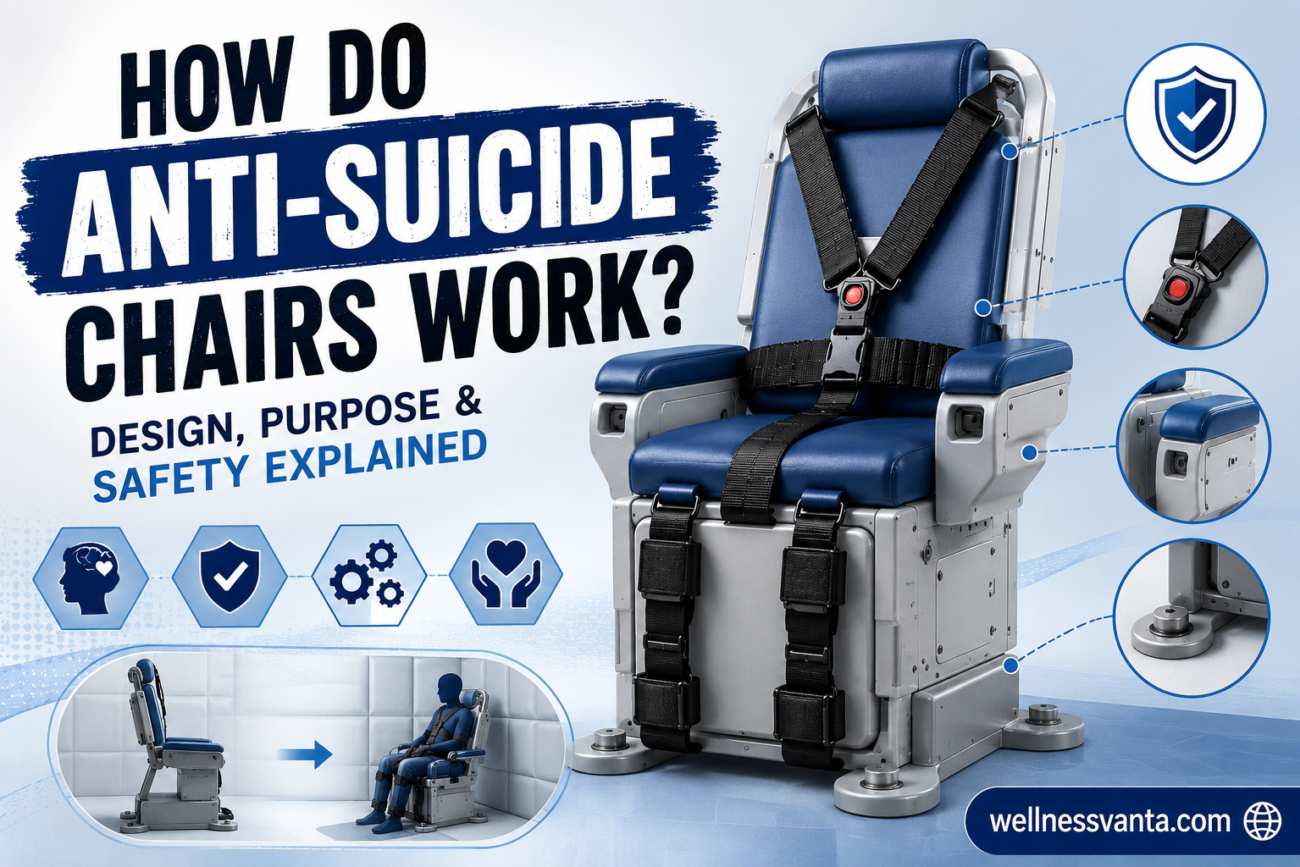
Mental health facilities, psychiatric wards, and correctional institutions face a quiet but constant design challenge: how do you furnish a space with everyday objects — chairs, beds, shelves — without those objects becoming instruments of self-harm? It is a question most people never think about, yet the answer shapes every detail of how these environments are built and equipped.
Anti-suicide chairs are one of the most considered solutions to this problem. They look, at first glance, like ordinary seating. But every curve, every material choice, every weight specification has been deliberately engineered with one overriding goal — to remove the physical opportunity for self-harm while preserving the dignity and comfort of the person sitting in them.
This article explains exactly how they work, what features define them, and why their design matters far more than most people realize.
What Is an Anti-Suicide Chair?
An anti-suicide chair — also referred to as a ligature-resistant chair or safety chair — is a piece of furniture specifically designed for use in environments where occupants may be at risk of self-harm or suicide. These chairs are standard equipment in psychiatric hospitals, crisis stabilization units, forensic mental health facilities, and certain sections of correctional institutions.
The defining characteristic is not any single feature but rather the deliberate absence of features that could be exploited. Standard chairs — even simple plastic ones — can be broken apart to create sharp edges, used as anchoring points for ligatures, or wielded as weapons. Anti-suicide chairs are engineered to eliminate each of these possibilities.
The Core Design Principles
No Ligature Points
The most critical design requirement is the complete elimination of ligature points — any gap, protrusion, or anchor point where a cord, strip of fabric, or similar material could be looped and used to create a noose. This rules out:
- Hollow tubular frames (where material can be threaded through)
- Open gaps between seat and backrest
- Armrest cutouts or decorative holes
- Exposed screws, bolts, or hardware
- Any right-angle junction that creates a hooking point
Anti-suicide chairs are designed with smooth, continuous, fully enclosed surfaces. The transition between the seat, backrest, and any armrests is typically a single flowing form with no accessible gaps.
No Sharp Edges or Breakable Parts
A chair that can be broken apart — whether through impact, sustained pressure, or disassembly — becomes a source of improvised weapons or cutting instruments. Anti-suicide chairs address this in two ways.
First, the materials used are specifically chosen for impact resistance. Heavy-duty rotationally moulded polyethylene is commonly used because it absorbs impact rather than shattering, and it does not produce sharp shards or splinters when stressed. Some chairs incorporate reinforced steel internal structures that prevent deformation while the outer shell remains smooth and soft-edged.
Second, any hardware used in construction is concealed entirely within the chair’s structure. There are no exposed screws to be removed and fashioned into tools, no bolts that can be worked loose, and no joints that can be levered apart with applied force.
Weight and Stability
Anti-suicide chairs are typically significantly heavier than their standard equivalents. This serves two purposes. A heavier chair is harder to throw or wield as a weapon, and it is harder to drag and position in a way that could facilitate harm. The low centre of gravity and broad base design that characterizes most models also makes tipping more difficult.
Some designs include floor-anchoring compatibility — pre-formed channels or recesses that allow the chair to be secured to the floor in particularly high-risk settings, while remaining moveable in others.
Non-Absorbent, Cleanable Surfaces
While not directly a self-harm prevention feature, the material requirements of a safety environment demand that anti-suicide chairs be manufactured from non-porous materials that can be thoroughly cleaned and disinfected. Fabric upholstery, foam cushions, and standard padding are all excluded — not only because they can be torn apart and used as tools or ligature material, but because infection control in clinical settings demands surfaces that withstand repeated chemical disinfection without degrading.
Materials Commonly Used
Rotationally Moulded Polyethylene: The most prevalent material in modern anti-suicide chair manufacturing. It is seamless, impact-resistant, cannot shatter, and can be moulded into complex flowing shapes without joints or gaps.
High-Density Polyethylene (HDPE): Similar properties to the above, used in some thicker-gauge models where additional rigidity is required.
Anti-Ligature Foam Composites: In chairs that include integrated padding for patient comfort, the foam is typically encased in a tear-resistant, welded membrane rather than stitched upholstery. There are no stitched seams that can be picked apart and no fabric that can be stripped into strips.
Powder-Coated Steel Internal Frames: Where steel is used for structural integrity, it is fully encased within the outer shell. It never forms part of the visible or accessible surface of the chair.
Where Anti-Suicide Chairs Are Used
These chairs are deployed in any environment where clinical assessment has identified a heightened risk of self-harm. Common settings include:
Acute Psychiatric Wards: Both open wards and locked wards in psychiatric hospitals use ligature-resistant furniture throughout, but particularly in bedrooms, day rooms, and seclusion areas.
Crisis Assessment Rooms: Emergency departments increasingly include dedicated psychiatric assessment rooms furnished entirely with safety-spec equipment, including anti-suicide seating.
Forensic Mental Health Units: Facilities housing individuals with mental health conditions who are also involved in the criminal justice system operate under particularly stringent safety requirements.
Correctional Facilities: Prisons and detention centres — where suicide rates are statistically elevated — use ligature-resistant furniture in observation cells, segregation units, and mental health wings.
Juvenile Detention and Care Facilities: Younger populations in secure settings present their own risk profiles, and purpose-designed environments in these facilities frequently incorporate similar safety furniture.
Do They Actually Work?
The honest answer is: they are one important layer in a multi-layered approach to safety, not a standalone solution.
Environmental design — including anti-suicide furniture — is classified in clinical literature under the broader concept of means restriction. The underlying evidence for means restriction as a suicide prevention strategy is strong. Reducing physical access to the means of self-harm demonstrably reduces completed attempts in controlled environments, even when psychological distress is unchanged.
However, no physical design can substitute for adequate staffing, consistent observation, therapeutic intervention, and compassionate care. A well-designed chair cannot prevent every conceivable harm. What it does is remove some of the easiest, most impulsive, and most accessible pathways — and in a crisis situation, that removal of immediate means can be the difference between an impulse acted upon and an impulse that passes.
Research published in psychiatric facility management literature consistently shows that ligature-resistant environments, when combined with appropriate clinical care, contribute meaningfully to reduced incident rates. The furniture is not the whole answer. It is part of a responsible, considered physical environment that supports the work being done by clinical staff.
The Dignity Factor
One aspect of anti-suicide chair design that is often overlooked in clinical discussions is aesthetics. Early generations of safety furniture were conspicuously institutional — heavy, ugly, and visually communicating to patients that they were considered dangerous. Modern manufacturers have invested significantly in closing the gap between safety-spec and standard furniture aesthetically.
Contemporary anti-suicide chairs are available in a range of colours, use softer and more welcoming profiles, and are increasingly difficult to distinguish from standard contract furniture at a glance. This matters clinically. An environment that feels punitive or dehumanizing actively works against therapeutic outcomes. A space that feels calm, considered, and respectful of the people in it supports them.
The best anti-suicide furniture today is designed with both safety engineers and interior designers involved in the process — because looking after someone’s physical safety and their psychological experience of a space are not competing goals. They are the same goal, approached from different angles.
Key Takeaway
Anti-suicide chairs work by systematically eliminating every physical feature that could be exploited for self-harm — ligature points, sharp edges, breakable components, removable hardware — while maintaining the basic function and, increasingly, the aesthetic comfort of ordinary seating. They are a product of careful, evidence-informed design, used within broader clinical environments where reducing means of harm is understood as an essential part of responsible care.
They are not a solution in isolation. But in the right setting, as part of a thoughtfully constructed environment and a well-resourced clinical team, they are a genuinely important tool.